Thank You, NotebookLM (Seriously, You Changed Everything)
By the time we hit our 25th article, we thought we had a pretty good rhythm. We were commuting, we were talking to our AI "research assistants," and we were slowly building a library we were proud of. We thought we knew what our content was.
Then, we met NotebookLM, and it completely changed the game.
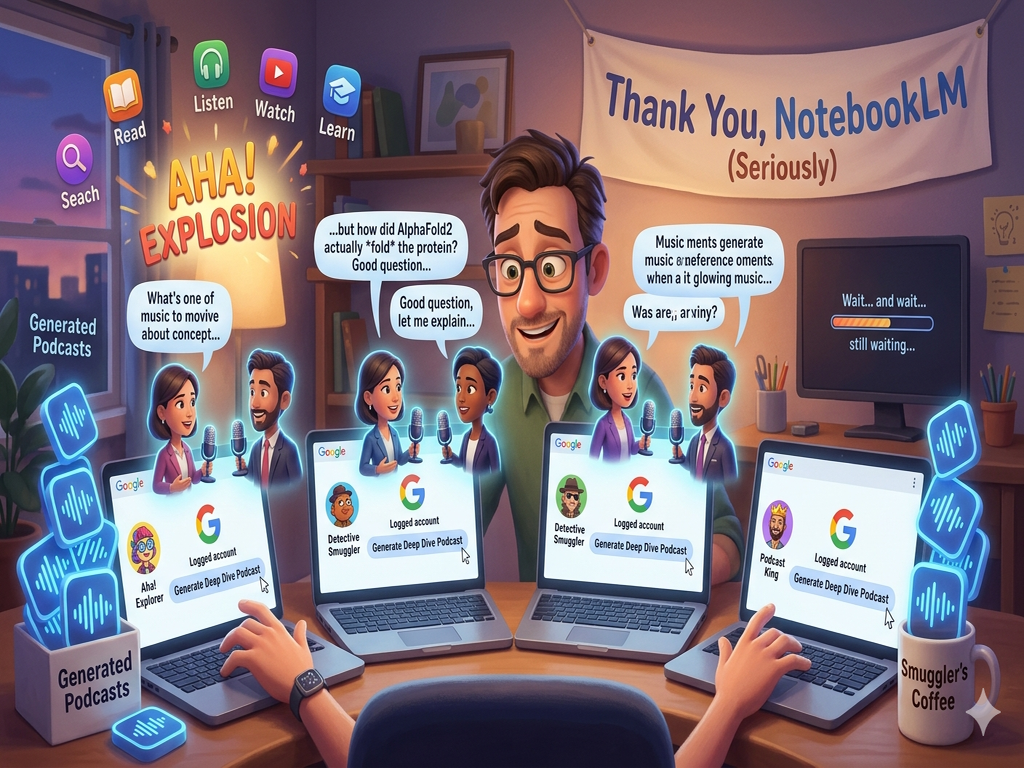
It started with the "Deep Dive" podcast feature. Back then, there was no video generation—just audio—but hearing our articles transformed into a conversation between two AI voices was, frankly, mind-blowing. It didn't sound like a cold machine reading a script. It sounded like two smart people sitting in a studio, bantering, asking the right questions, and explaining our ideas back to us.
That's when the "Aha!" hit: Sometimes, people don't want to read. Sometimes, they just need to hear it.
Of course, we ran into a very human problem: the daily generation limits. Now, I'm not saying we're proud of this, but we're also not saying we wouldn't do it again—we went into "detective mode," dug up every old Google account we've ever owned, and used them to generate podcasts for all 25 of our existing articles. We just couldn't wait.
What surprised us most was how focused it was. We'd just give it a little nudge on what mattered to us, and it would pick up the scent and run with it. It turned our static text into a living learning tool.
Fast forward to today, and the evolution hasn't stopped. Now that there's video support, our articles have "three doors" for learners to walk through:
You can read when you want to slow down and think.
You can listen while you're stuck in traffic (our favorite pastime).
You can watch when you're curious and want a visual edge.
It makes the content feel richer, more flexible, and—honestly—more human.
This realization is starting to bleed into everything else we're building at the AI Bridge Foundation, including our AI Challenge Lab. We haven't fully plugged NotebookLM into the Pinned AI Tutor yet—mostly because the tutor is about real-time interaction while NotebookLM is about source materials—but we are exploring the possibilities. How could we not?
We've heard stories of doctors using this tech to break down dense medical papers across different languages. If it can help a surgeon understand a complex procedure, imagine what it can do for a student trying to wrap their head around the GED.
Is it perfect? Not quite. The "waiting game" is real. You hit generate and then you wait... and wait... and check your email... and wait. It's not exactly a shot of adrenaline. But almost every single time, when that audio starts playing, the result makes the wait worth it.
So, thank you, NotebookLM. You didn't just help us create content; you helped us experience it. You showed us that an article doesn't have to stay on the page—it can talk, it can move, and it can meet a learner exactly where they are.
We're still just getting started, but the bridge is looking a lot wider than it used to.