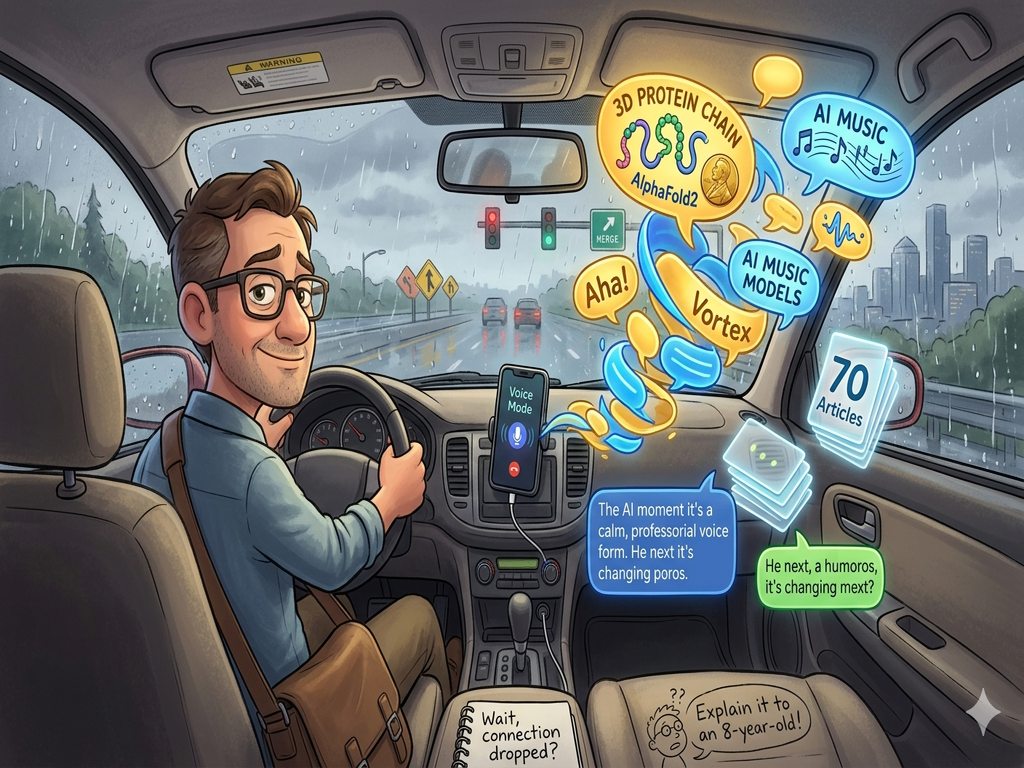
We Didn't Sit Down to Write 70 Articles. We Talked Our Way Into Them.
We have about 70 articles in our library now, and if you pictured me sitting at a balanced mahogany desk with a carefully planned outline and a steaming cup of artisan coffee, I have a confession to make: That isn't even close to the truth. There was no quiet desk. No "writing time." In fact, most of these articles began somewhere between a red light and a highway merge during my morning commute.
For the last few months, my car has been my classroom, and my phone has been my research assistant. I'd open voice mode on Gemini or ChatGPT—whichever one I felt like talking to that morning—and just start. No strict rules, no set agenda. Just a 30-minute drive and a lot of curiosity.
At first, it was just a way to kill time. I'd pick a topic I vaguely heard about and start digging. One morning, it was Google DeepMind's AlphaFold2. I knew it had won a Nobel Prize, but I didn't actually know why protein folding was such a massive deal or why it took so long for humans to do it without AI. So, while navigating traffic, I just asked. I'd literally say, "Explain it to me like I'm 8 years old."
And it did. Not perfectly, and not always on the first try, but enough to keep me asking questions. I'd simplify, I'd push back, and I'd try to extract those three or four "gold nugget" points that actually made sense to me. Some days, 30 minutes wasn't nearly enough. I'd pull into the parking lot at work mid-conversation, still trying to wrap my head around how AI generates music or why certain neural models behave the way they do. But strangely, that was the best part—arriving at work knowing something I hadn't even thought about when I left my driveway.
Of course, it wasn't always a smooth, futuristic experience. There were plenty of moments where I wanted to toss my phone out the window. Voice interaction can be incredibly frustrating. I noticed Gemini would sometimes change its voice every single turn, like it was having an identity crisis. ChatGPT felt different—it almost seemed to adjust its tone based on how I was speaking, which I'm still not entirely sure wasn't just my imagination.
Then there were the technical struggles. Connection drops. App crashes. Voice cutting out just as the AI was reaching a breakthrough explanation. I'll admit, I've raised my voice at the dashboard a few times. Probably less than five... but it definitely happened.
Yet, I kept coming back to it. Over time, without me doing anything differently, the experience just got better. The conversations became more natural, the flow started to feel real, and I actually started looking forward to my time in traffic. It turned small, otherwise wasted moments into something meaningful.
The pattern was always the same: Talk. Ask. Get confused. Ask again. Repeat. At the end of the drive, I'd stop the voice mode and switch back to text. I'd ask the AI to take our rambling, 30-minute brain-dump and summarize the main points or create a long-form draft I could actually work with. I'd send that draft to my email, and later that day, I'd polish it into a finished piece.
That's how we ended up with 70 articles. We didn't start with "writing." We started with conversation. We didn't sit down to build a library; we just kept talking until a library appeared. It taught me that you don't need the perfect environment to create something worth sharing—you just need a 30-minute commute and the willingness to ask a "stupid" question until you finally get a smart answer.