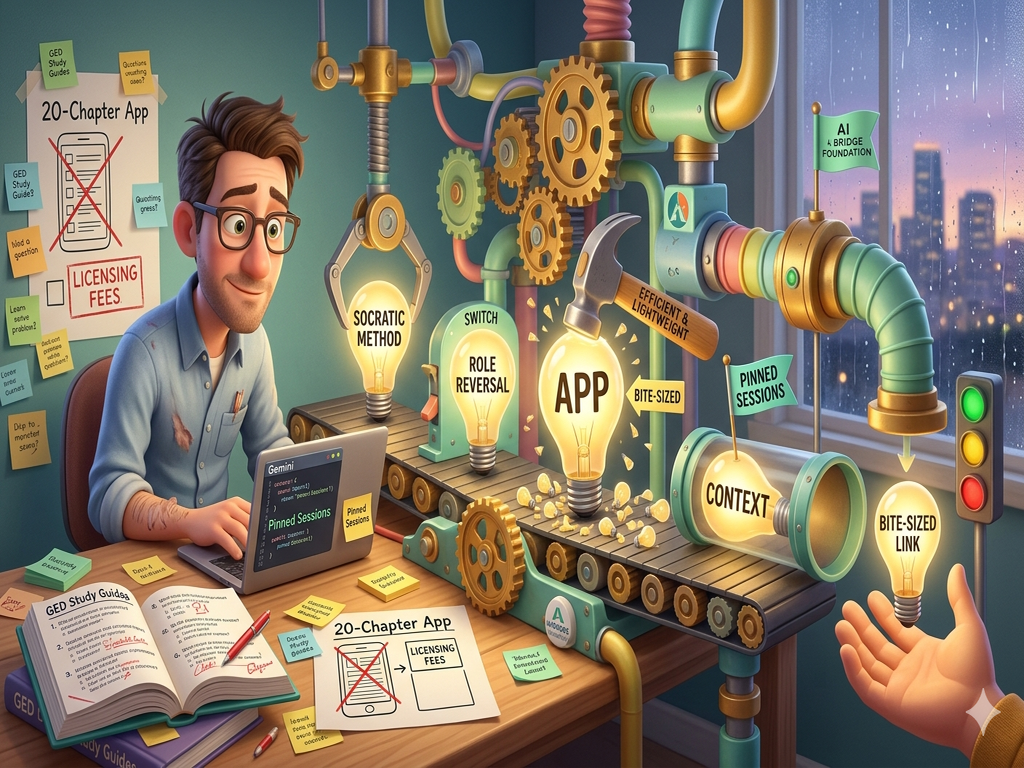
The "Aha!" Moments That Built Pinned AI Tutor
When we first started thinking about building something for learners, it didn't have a name. It wasn't even "Pinned AI Tutor" yet. In fact, it barely looked like a product at all. It looked more like a person (me) hunched over a laptop, obsessively poking at ChatGPT and Gemini to see what would happen.
Then came the first Aha! moment.
We noticed something subtle but powerful: AI is a terrible teacher if you just ask it for answers, but it's a brilliant guide if you force it to be one. If the AI nudges instead of explains—or even better, if the student "teaches" the AI—real learning starts to happen. We weren't reading academic papers at the time; we were just following a gut feeling that "flipping the classroom" felt right.
We wanted to move past our own assumptions, so we went to the source. We spoke with former GED teachers and spent way too much time in Reddit threads and Facebook groups where learners share their raw, unfiltered struggles.
That led to another Aha! moment.
The problem wasn't just academic. It was life. We saw adults trying to study during 15-minute lunch breaks, parents sneaking in a lesson after the kids finally fell asleep, and people trying to grasp social studies concepts while literally driving to work. These weren't students with a library and a quiet desk; these were people fitting learning into the "cracks" of a chaotic day. They weren't just missing knowledge—they were missing a bridge that actually fit into a 15-minute window.
Meanwhile, we kept testing the limits of the big AI models. That led to realization number three.
The AI was already good. Surprisingly good. It could explain GED-level material with more patience than any human I know. So the issue wasn't capability. The issue was usage.
In the beginning, we tried the "obvious" path: building a massive, all-in-one GED app. We hit a wall immediately. Between licensing headaches and technical overhead, we realized something humbling: we couldn't outbuild the tech giants.
That struggle forced another Aha! moment. Maybe we shouldn't try to replace the AI tools. Maybe we should just steer them.
Still, one problem kept me up at night: progress. How do you actually know if someone "gets it"? A single test feels shallow. A hundred tests feel like a root canal. We were stuck until, unexpectedly, the next Aha! moment came from my own disorganized work habits.
I was using Gemini's "pin" feature to organize research for some articles I was writing. I realized how much I depended on that one focused, "pinned" thread to keep me from drifting into a thousand other tabs.
That's when it clicked. What if every learner had that same experience? What if instead of one giant, intimidating app, we gave them small, focused, "pinned" sessions—one for each specific subtopic?
Everything started to fall into place. We stopped dreaming of a 20-chapter system and started imagining something lightweight. A student gets a single link and lands in a bite-sized session. They don't need to see the whole mountain; they just need to see the pebble right in front of them. We built "anchor prompts" behind the scenes to keep the AI in its Socratic role—checking understanding often and refusing to just give away the answers.
Then, almost as if the universe wanted to give us a high-five, one more moment happened.
A YouTube recommendation popped up (thanks, algorithm). It was a Harvard study about an AI tutor. As we watched, we realized they were describing exactly what we had been building—the role-switching, the guided questioning, the active learning. It was a rare, validating moment. We hadn't followed the research; we had just listened to the learners, and somehow we'd ended up in the same place.
From there, the final shape of Pinned AI Tutor became clear.
We decided to stay lightweight and honest. Our tutoring happens directly inside ChatGPT or Gemini, which means our students benefit from every billion-dollar update those companies make. Because we aren't spending our budget on massive servers, we can use our resources to give students access to the best tools—even using grant money to buy pro-level subscriptions for them.
We even kept the progress tracking simple: Red, Yellow, Green. A traffic-light system based on the AI's subjective feedback. It's not a complex data dashboard, but it's clear enough to tell a student, "You've got this, move to the next link."
Pinned AI Tutor didn't come from a single "Big Idea." It came from a lot of small, honest, and sometimes frustrating "aha!" moments. We're not trying to build a tech empire. We're just trying to figure out a better way for people to learn with the tools that already exist—and to make sure they don't have to do it alone.