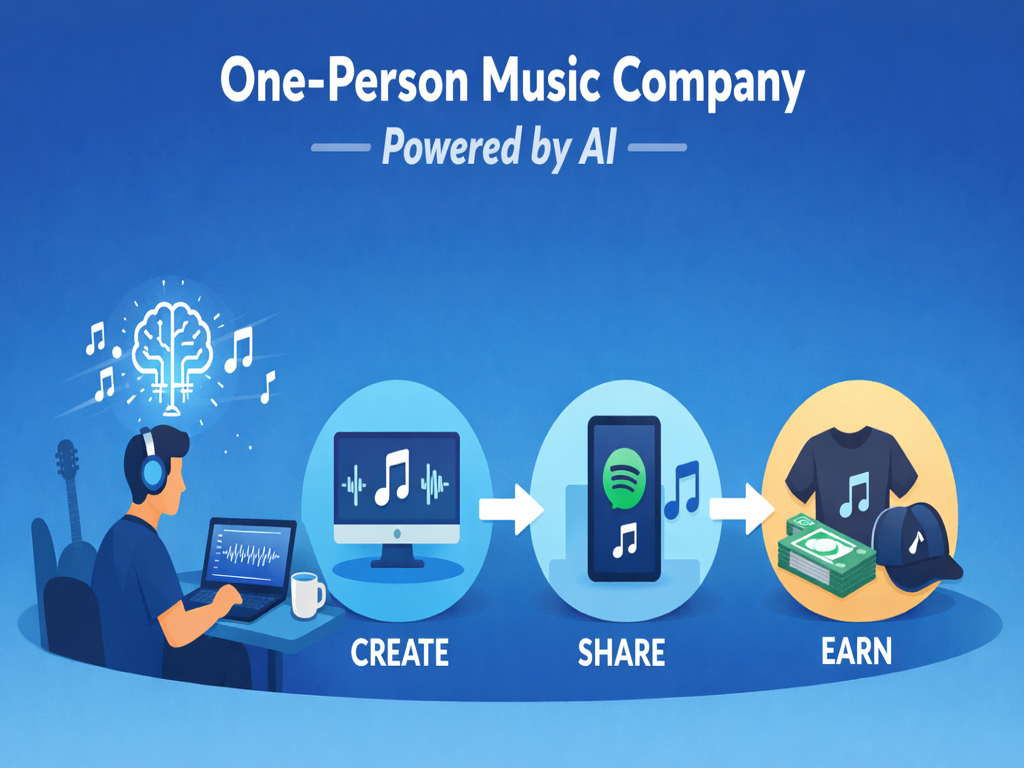
The One-Person Music Company: How AI and Streaming Make Solo Music Creation Possible
For many people, music feels almost magical. A song appears on Spotify, we press play, and that's it. But behind those three minutes of sound is a surprisingly structured process—one that has become more accessible than ever thanks to technology, AI, and streaming platforms.
What used to require studios, labels, managers, and large budgets can now be done by a single person with the right tools and mindset. This article walks through that process step by step, from creating music to actually making money from it, in a way that anyone can understand.
Music Production — Turning Ideas Into Sound
Everything starts with production. This is where raw ideas become actual music.
Some people are great at writing lyrics. Others excel at creating melodies, beats, or guitar riffs. Modern music production allows these skills to exist independently or together. You don't need to be good at everything anymore.
Most music today is created using a Digital Audio Workstation (DAW). A DAW is software that lets you record vocals, arrange instruments, edit sounds, and build an entire song on a computer. Tools like BandLab and Soundtrap are beginner-friendly and web-based, while FL Studio, Ableton Live, and Logic Pro are more advanced options.
This is where AI starts to quietly change everything. AI tools can help generate beats, chord progressions, background music, or even suggest melodies. For someone starting alone, this removes the "blank page" problem. You don't have to invent everything from scratch—you can react, adjust, and shape ideas.
The key point is that AI doesn't replace the artist. It speeds up experimentation and fills in gaps. The final decisions—what stays, what goes, and what the song feels like—still come from the human.
Most streaming songs today land in the two-to-four-minute range. The goal isn't length. It's clarity, energy, and engagement.
Roles in Music Creation — You Don't Have to Do Everything
Music creation is not a single job. It's a collection of roles.
There's the songwriter who focuses on lyrics and storytelling. There's the producer shaping the sound. There's the performer delivering emotion. Traditionally, these were separate people. Labels assembled teams to cover each role.
Today, even solo creators still play these roles—but they don't have to master all of them equally. AI and modern software allow one person to focus on their strengths while getting support elsewhere.
If writing lyrics is your strength, AI can help generate instrumental ideas. If sound design is your thing, AI can help with lyric prompts or vocal demos. Understanding this division helps beginners stop feeling overwhelmed. You're not failing because you're "bad at everything." You're just learning how to assemble your process.
This is the foundation of the one-person music company: not doing everything perfectly, but managing the whole workflow intelligently.
Fine-Tuning — Making the Music Sound Professional
Once a song is created, it usually isn't finished.
Fine-tuning includes mixing and mastering. Mixing balances vocals, instruments, and effects so the song feels clear and intentional. Mastering prepares the track so it sounds good across phones, cars, headphones, and speakers.
This step matters more than many people realize. A strong song with weak mixing can sound amateur. A modest song with good polishing can sound professional and competitive.
In the past, this required expensive studios or engineers. Today, AI-assisted mixing and mastering tools lower that barrier. They don't eliminate skill, but they make acceptable quality reachable for individuals.
For a solo creator, this means fewer bottlenecks. You don't have to wait or spend thousands just to move forward.
Copyright and Originality — Avoiding Problems Before They Start
One common fear is accidentally copying someone else's music.
In reality, similar rhythms and chord progressions are common. What matters is avoiding direct copying of melodies, lyrics, or recognizable samples. When using AI tools, it's important to use platforms that clearly state their output is original and safe for commercial use.
Some creators use audio comparison tools to check whether a track closely resembles existing songs. Nothing is ever 100 percent guaranteed, but originality, documentation, and good faith effort go a long way.
Lyrics, melodies, and recordings are protected by copyright as soon as they're created. Keeping drafts, timestamps, and files is a simple habit that protects creators later—especially when operating as a one-person business.
Distribution — How Music Gets Onto Spotify
Artists cannot upload music directly to Spotify. Instead, they use distributors like DistroKid, TuneCore, or CD Baby.
These services send music to streaming platforms, track performance, and collect royalties. Some charge yearly fees, others take a percentage. This is one of the first business decisions a creator makes.
Once the music is live, artists manage their presence through tools like Spotify for Artists. This provides listener data, geographic insights, and playlist submission options.
For a solo creator, distribution is where art officially becomes a product.
Marketing — Music Doesn't Promote Itself
Uploading music is not the same as being heard.
Marketing today happens through short videos, social media, storytelling, and consistency. Playlists function as the new radio. Visibility often comes from momentum, not a single release.
This is where many artists realize they're not just musicians—they're also content creators. In the past, labels handled this. Today, individuals do.
AI can help here too. It can assist with captions, content ideas, scheduling, analytics interpretation, and even basic visual assets. For a one-person company, this means less time guessing and more time creating.
Monetization — How Artists Actually Make Money
Streaming royalties are one income source, not the whole picture. Each stream pays a small amount, so income depends on scale and consistency.
Beyond streaming, artists earn through live performances, merchandise, licensing, fan subscriptions, teaching, and brand collaborations. Many successful creators think in terms of ecosystems, not single hits.
Some artists form small business entities or even micro record labels, even if they're the only employee. Others stay independent and informal. Both approaches can work. The key is understanding that music today sits at the intersection of creativity and entrepreneurship.
The Big Picture — A Level Playing Field With Real Competition
Thousands of songs are released every day. The barrier to entry is low, but the competition is real.
Technology and AI have leveled access, not effort. Quality, clarity, and persistence still matter. The difference now is that individuals are no longer locked out by cost or gatekeepers.
A single person can create, refine, distribute, promote, and monetize music—with the right tools and learning mindset.
The Bigger Picture
Making and selling music today is no longer mysterious, but it isn't instant either. It's a creative, technical, and strategic process.
For anyone willing to understand the steps, use AI as leverage, and focus on quality, music can be more than a passion. It can function like a small company—run by one person, powered by modern tools, and limited more by imagination than access.