AI Fluency and a New Path Into Local Business
Across cities and towns, there are people who know how to do real work. They know how to move furniture without damage, maintain yards efficiently, clean buildings thoroughly, repair fences, paint interiors, or haul debris safely. These are not abstract skills. They are learned through experience, repetition, and responsibility.
Yet many of these individuals remain stuck doing informal jobs or working for others, not because they lack ability, but because the business side feels overwhelming. They don't know how to register a business. They're unsure how pricing should work. They don't know how to set up a website, send invoices, or manage scheduling without chaos. The work itself is clear. Everything around it feels opaque.
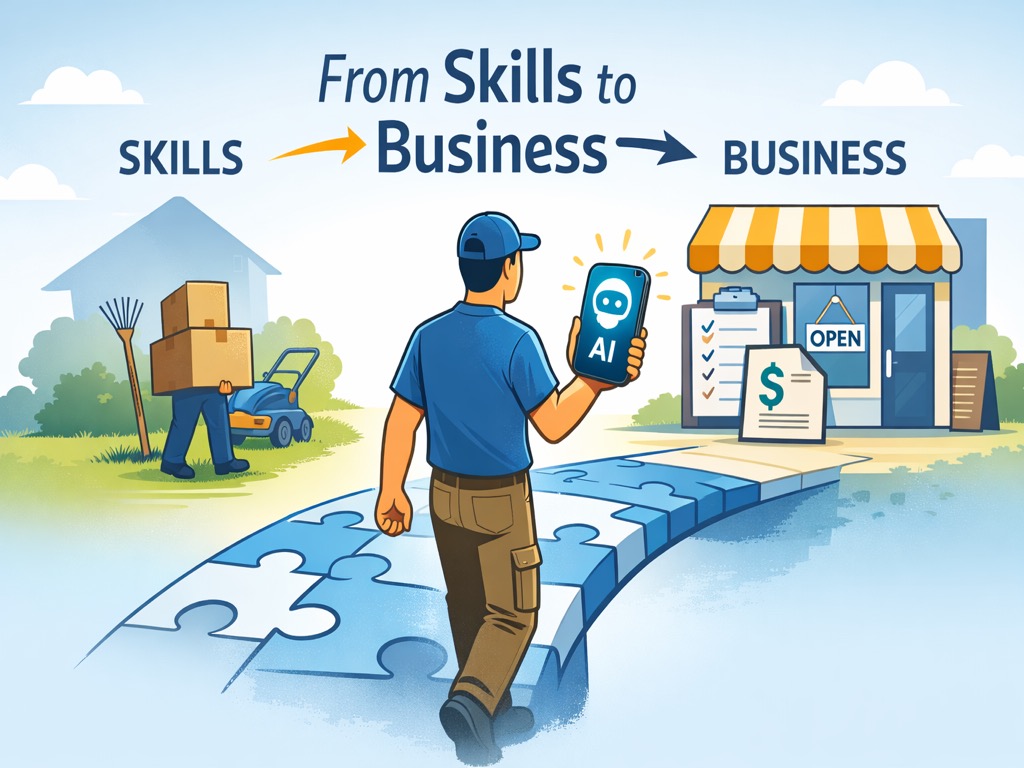
This is where AI fluency begins to matter—not as technology hype, but as a practical bridge.
Every Local Service Has a System
Even the simplest local business follows a structure, whether the owner realizes it or not.
A customer has to find the service. A job has to be described, priced, and scheduled. The work has to be completed. Payment has to be collected. Records have to exist. Trust has to be built so the next customer feels safe making the call.
In the past, people learned this structure slowly, often through mistakes. Some relied on family members who had run businesses before. Others paid accountants, consultants, or platform fees they didn't fully understand. Many simply avoided formalizing altogether.
AI changes this by making the structure visible while you are inside it.
Making the Business Real on Paper
For many first-time business owners, the moment they consider registering a business is also the moment they freeze.
Questions pile up quickly. Should this be a sole proprietorship or an LLC? What does that even mean? Do I need a license? What if I do it wrong? What if it costs too much? What if I create a problem for myself?
AI does not replace state governments or legal requirements, but it does something essential: it explains the process in plain language. Someone can ask what it means to register a small moving business in their state and receive a step-by-step explanation of what typically applies and what usually doesn't. They can learn why an EIN exists, when it's needed, and when it isn't. They can understand which steps are mandatory and which are optional at the beginning.
This clarity lowers fear. And when fear is lowered, action becomes possible.
Turning Skill Into a Professional Presence
Once a business exists, even in a simple form, the next challenge is trust.
Imagine two moving services. One is mentioned through a friend of a friend, with only a phone number. The other has a basic website that clearly explains services, service areas, pricing approach, and how to get a quote. The second one feels safer, even if the quality of work is identical.
AI-powered website tools help bridge this gap. Someone who has never written "business copy" can describe their services in everyday language and ask AI to help organize it clearly. They can create a simple site with a contact form and basic explanations without learning design or coding.
This is not about looking big. It's about looking reliable.
Finding Work Without Chasing It
Traditionally, small service businesses relied heavily on word of mouth. That still matters, but it is slow and unpredictable.
Today, platforms connect customers who actively need help with service providers who are ready to work. The challenge for new operators is standing out and responding professionally. Many lose opportunities simply because they don't know how to write a clear response or price a job confidently.
AI helps here in very practical ways. It can help draft responses to customer inquiries that explain services clearly and politely. It can help compare similar jobs and suggest reasonable pricing ranges. It can even help analyze which types of jobs consistently lead to profit and which ones cause stress without enough return.
Over time, this turns guesswork into learning.
Pricing Without Undervaluing Yourself
One of the most common problems in informal work is underpricing.
People charge what "feels fair" or what they think customers will accept, without accounting for time, travel, wear on equipment, or unpredictability. This leads to exhaustion, resentment, and burnout.
AI does not decide prices, but it helps structure thinking. It can help someone break down a job into components: labor time, distance, materials, and overhead. It can help explain pricing clearly to customers so it feels transparent rather than arbitrary.
This shifts pricing from emotion to reasoning.
Running Operations Alone Without Losing Control
Once work begins to flow, organization becomes critical.
Missed appointments, forgotten invoices, or last-minute confusion can undo trust quickly. For someone working alone, these mistakes are not signs of laziness—they are signs of overload.
AI-assisted tools integrate calendars, reminders, quotes, and invoicing into a single flow. A landscaping job can be scheduled, confirmed automatically, completed, invoiced, and paid without manual back-and-forth. This reduces mental strain and frees attention for the actual work.
The business starts to feel manageable instead of fragile.
Getting Paid and Seeing the Business Clearly
Many skilled workers delay invoicing or feel uncomfortable asking for payment. Some lose track of who paid and who didn't. Others avoid looking at income entirely because it feels stressful.
AI-powered invoicing and payment systems change this dynamic. Invoices are sent promptly. Payments are tracked automatically. Income and expenses are visible in one place. This visibility allows better decisions, such as when to accept more work and when to slow down.
Clarity replaces anxiety.
Reputation Becomes Momentum
In local services, reputation is often more powerful than advertising.
Clear communication, punctuality, and follow-up matter. AI helps maintain consistency in messages, confirmations, and review requests. Over time, positive feedback accumulates. Future customers don't just see a service—they see proof.
This is how one job quietly leads to the next.
AI Fluency Is Not About Replacing Work
AI fluency does not mean becoming technical or giving up hands-on labor.
It means knowing how to use AI as a guide through systems that were once difficult to access. It means understanding how to ask questions, evaluate answers, and apply information to real situations. It means turning confusion into steps.
For people who already know how to work, this is transformative.
Final Thought
Local economies depend on skilled individuals. Too often, those individuals are locked out of formal participation not by lack of effort, but by lack of access to information.
AI fluency changes that equation. It allows one person to register a business, present professionally, find customers, manage operations, and get paid—without needing a team or prior business experience.
This is not about automation. It is about access.
When people who know how to do the work can also navigate the system around it, opportunity expands. And that expansion happens one small business at a time.