Stop Guessing: How Small Businesses Can Use AI to Charge the Price Customers Want to Pay
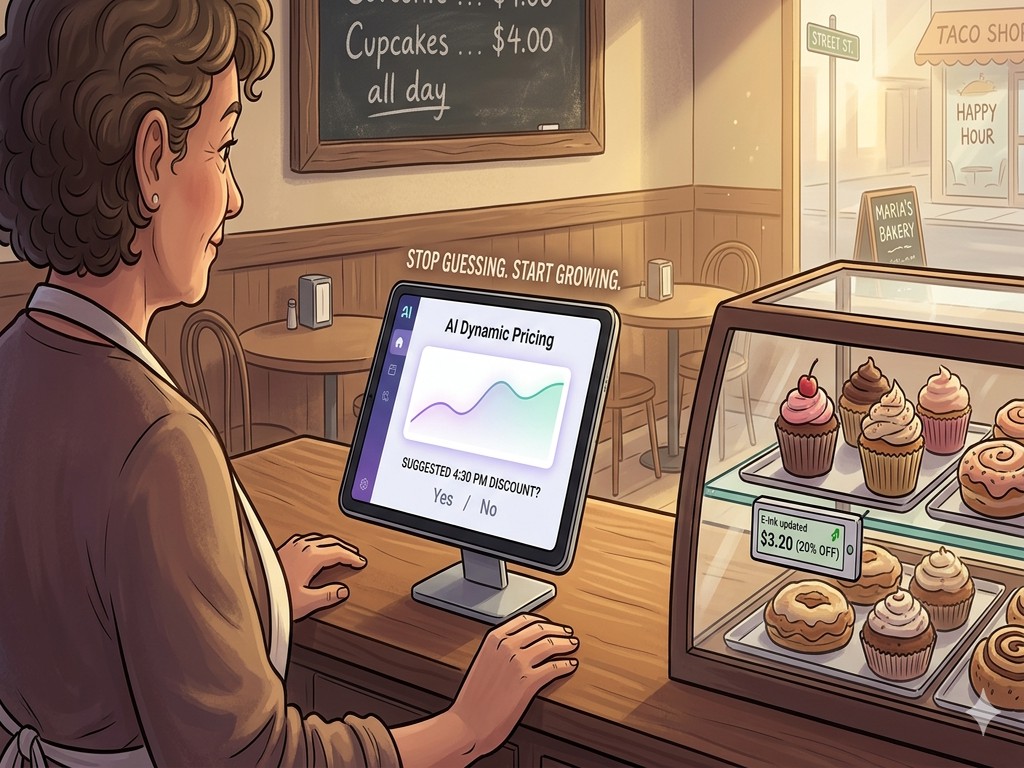
The bell above the bakery door barely made a sound anymore. By 4:30 PM, the rush was over. The morning crowd—parents juggling coffee and kids, commuters grabbing something warm—had long disappeared. What remained was a quiet room, the faint hum of a refrigerator, and a glass case still half full of cupcakes that wouldn’t make it to tomorrow.
Maria stood behind the counter, doing what she’d always done: guessing. Should she mark them down? By how much? Too little, and they’d sit there. Too much, and she’d wonder if she’d just given away her margin. Pricing, for her, wasn’t strategy. It was instinct, repetition, and a quiet kind of stress that never quite left.
The Hidden Power of Dynamic Pricing
Across the street, a chalkboard sign outside a taco shop offered a different story. It read: “Happy Hour: $4 Tacos, 3–5 PM.” By dinner, those same tacos would be $8—and no one complained. Everyone understood that. What Maria didn’t realize—what most small business owners don’t—is that this simple, familiar idea has a formal name: dynamic pricing.
For a long time, it was something only airlines, hotels, and tech giants seemed to wield. It felt opaque, even a little predatory. We’ve all felt the sting of a ride-share price doubling because it started raining. But that perception is starting to crack. Because at its core, dynamic pricing isn’t about squeezing customers; it’s about matching price to reality. It is the quiet rhythm of demand that every small business already feels but rarely has the tools to measure.
Moving Beyond the "Cost-Plus" Guessing Game
For decades, small businesses have relied on cost-plus pricing. You add up ingredients, labor, and overhead, tack on a margin, and hope for the best. It’s logical and safe, but it’s often disconnected from the human experience. Customers don’t experience cost; they experience value.
An umbrella isn’t worth the same thing on a sunny day as it is in a downpour. Yet, many businesses price as if every day feels the same. Dynamic pricing simply acknowledges that context matters. When Maria prices her cupcakes at a flat rate all day, she might be overcharging the late-afternoon customer who is taking a risk on a "day-old" taste, while potentially undercharging the early riser who is paying for peak freshness.
AI as the Quiet Observer
This is where AI enters—not as a robot taking over the shop, but as a quiet observer. Imagine a system that notices patterns Maria can’t track in her head, such as how Tuesdays are consistently slower than Thursdays, or how a local high school football game triples foot traffic for exactly two hours on a Friday night.
Modern AI tools now act as a digital bookkeeper that doesn't replace Maria’s judgment but sharpens it. Instead of Maria staring at the cupcakes with uncertainty, the system observes the data and suggests a path forward. In real-world applications, businesses implementing these simple AI shifts often see a surprising lift in revenue, sometimes as high as 15%. This doesn’t happen because they are taking advantage of people during busy times. It happens because they are finally capturing "hidden demand."
Turning "Ghost Hours" into Profit
Think of a boutique gym with a 2 PM yoga class that usually sits empty. By using AI to identify that lull and automatically dropping the rate for that specific hour, the gym fills the room. The customer gets a deal they can afford, and the business turns a "dead" hour into a profit center. The same applies to a cleaning service that offers a slightly lower rate on a Tuesday morning to fill a gap in the schedule, or a consultant who adjusts rates based on seasonal demand.
Of course, there is a delicate line to walk. Not long ago, a major fast-food chain floated the idea of “surge pricing,” and the reaction was swift and angry. Customers didn’t hear nuance; they heard that it would cost more simply because they were hungry. The lesson for small businesses is that transparency and framing change everything. A price increase during a rush can feel like a penalty, but a discount for off-peak hours feels like a gift. The technology behind both is identical, but the story you tell determines whether you build trust or break it.
Scaling Smarter with Automation
Small businesses have a massive advantage here because they have real relationships. When a business owner uses these tools to offer "Sunset Discounts" or "Early Bird Specials," they aren't just optimizing a spreadsheet; they are fitting more naturally into their customers' lives. A group of teenagers might discover they can grab a treat after school that usually fits out of their budget. A freelancer might start timing their visits for quieter hours, enjoying both a lower price and a calmer workspace.
The most exciting part of this shift in 2026 isn't the complexity—it’s the accessibility. You no longer need a data science degree or a team of developers to stop guessing. Maria didn’t install a complex mainframe; she toggled a setting in the point-of-sale system she already used. She started small, testing the waters with one product. She set "floor" and "ceiling" prices so the AI could never charge more or less than she was comfortable with, ensuring she always stayed in control of her brand.
The End of Uncertainty
Maria still stands behind the counter most afternoons. The bell still rings, sometimes softly, sometimes in bursts. But the nagging uncertainty has faded. In its place is something steadier. Not perfect knowledge, but a clearer sense of when to hold firm and when to adjust.
She is no longer throwing away cupcakes at the end of the day, and her customers are happy to help her clear the shelves. She stopped reacting to her business and started responding to her community. It turns out that when you stop guessing, you start growing. And that is exactly what AI for everyone is supposed to look like.