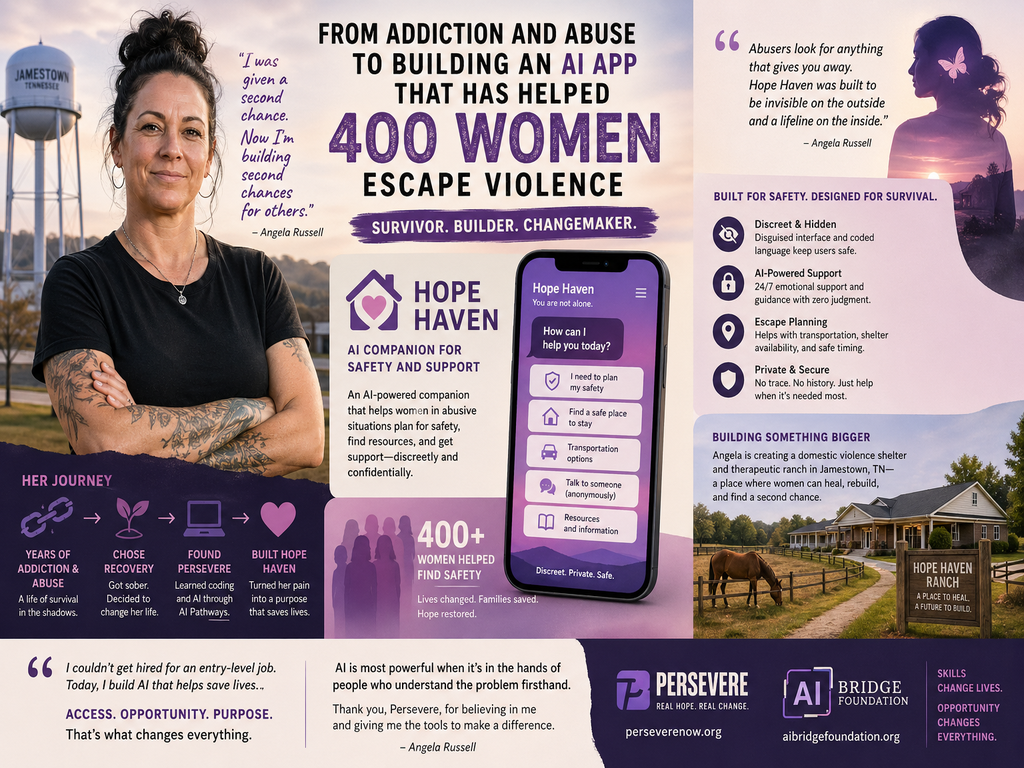
From Addiction and Abuse to Building an AI App That Has Helped 400 Women Escape Violence
Angela Russell's path to becoming an AI builder didn't start in a classroom or a tech company. It started with survival — years of it — in places where technology was the last thing on anyone's mind.
A Life Shaped by Hardship
Angela grew up in Florida and eventually settled in Jamestown, Tennessee — a small rural town tucked into the Cumberland Plateau, where opportunities are scarce and second chances are even scarcer. For years, her life was defined by addiction and domestic violence. She lived through things most people only read about, and she carried the scars — visible and invisible — of both.
Getting sober was the hardest thing she'd ever done. But staying sober while trying to rebuild a life turned out to be its own kind of battle. After two years of sobriety, Angela was ready to work. She was willing to do whatever it took — any job, any shift, any starting point. But employer after employer turned her away. A criminal background and gaps in her resume were all they could see. Nobody was interested in the person behind the paperwork.
It's a story that plays out thousands of times a day across America. People who've done the work to change their lives, only to find that the world hasn't made room for them yet.
Finding Persevere
That changed when Angela discovered Persevere, a nonprofit that teaches coding and AI skills to justice-impacted individuals. Persevere doesn't just offer classes — it offers a genuine second chance built on real, marketable skills that the economy actually values.
Through their AI Pathways curriculum, Angela didn't just learn about artificial intelligence in the abstract. She learned how to build with it — how to take a problem she understood deeply and turn it into something that could help other people. And she knew exactly what she wanted to build, because she'd lived it.
Hope Haven: AI That Saves Lives
Drawing from her own experience as a domestic violence survivor, Angela created Hope Haven — an AI companion designed to help women safely escape abusive situations.
Hope Haven isn't a typical app. It's built with the hard-won understanding that abusers often monitor their partner's phone, check their browsing history, and control their communications. The app uses coded language and disguised interfaces so it can't be easily detected. From the outside, it looks like something ordinary. On the inside, it's a lifeline.
Hope Haven helps arrange escape logistics — transportation, shelter availability, safe timing windows — and provides emotional support without judgment, available around the clock. It meets women exactly where they are, in the most dangerous moments of their lives, and helps them take the next step when they're ready.
Since its launch, Hope Haven has helped more than 400 women take steps toward safety.
Four hundred women who might not have found a way out. Four hundred families changed. And it was built by someone the system had written off — someone who, not long before, couldn't get hired for an entry-level job.
Building Something Bigger
Angela isn't stopping with the app. She's now working to open a domestic violence shelter and therapeutic ranch in Jamestown — a physical place where women can heal, rebuild, and find the same kind of second chance she found through Persevere. A place where recovery isn't just about getting out, but about building something new.
In a town where resources are thin and support systems are stretched, Angela is creating infrastructure that didn't exist before. She's not waiting for someone else to solve the problem. She's solving it herself, with the skills she learned and the experience she lived.
Why This Story Matters
Angela's story is proof of something we believe deeply at AI Bridge Foundation: AI is most powerful when it's in the hands of people who understand the problem firsthand.
Angela didn't need a computer science degree to change lives. She didn't need venture capital or a Silicon Valley network. She needed access to learning, a program that believed in her potential, and the space to build something that mattered.
That's what programs like Persevere provide. They don't just teach technology — they unlock the ability of people who've been overlooked to solve problems that the tech industry doesn't even see.
Angela saw the problem. She had the lived experience. AI gave her the tools. And now over 400 women are safer because of it.
That's the kind of AI success story worth telling.
Sources & Further Reading
- Persevere — Angela Russell's Story — Original success story from Persevere
- Persevere — Nonprofit teaching coding and AI to justice-impacted individuals